
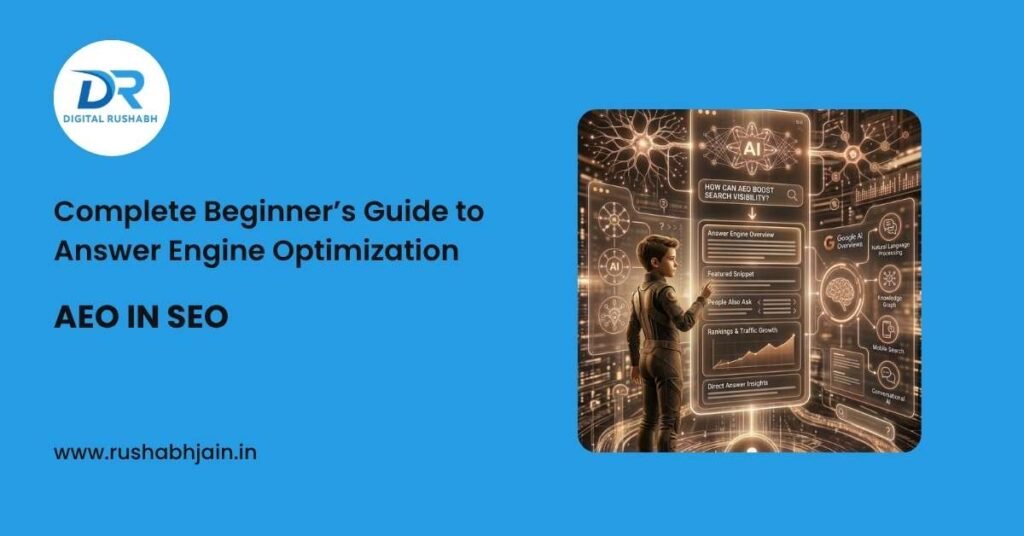
1. Introduction

The world of search engine optimization is evolving faster than ever before. Traditional SEO strategies that once focused mainly on keywords, backlinks, and rankings are no longer enough to dominate search results in 2026. With the rapid rise of artificial intelligence, users are now searching differently, and search engines are responding differently as well. This shift has introduced a completely new concept in digital marketing known as AEO in SEO, or Answer Engine Optimization.
Today, people no longer want to scroll through multiple websites to find answers. Instead, they expect direct, accurate, and conversational responses instantly. Whether someone searches on Google, asks ChatGPT a question, uses voice assistants like Alexa or Siri, or relies on AI-powered platforms such as Gemini and Perplexity AI, the expectation is the same — quick and precise answers.
This changing user behavior is exactly why Answer Engine Optimization (AEO) is becoming one of the most important trends in modern SEO.
Search engines themselves are also changing rapidly. Google has introduced AI-powered features like Google AI Overviews and Search Generative Experience (SGE) that provide summarized answers directly within search results. Instead of showing only blue links, Google now attempts to answer user queries instantly using AI-generated content pulled from various sources.
Similarly, platforms like ChatGPT and Perplexity AI are reshaping how users consume information online. People are increasingly relying on AI-generated answers rather than visiting multiple websites manually. This has created a major transformation in the digital marketing landscape.
For businesses, agencies, and even a digital marketing freelancer in Mumbai, adapting to this shift is becoming essential. Clients today expect faster answers, smarter strategies, and AI-driven solutions. Businesses are no longer looking only for traditional SEO services — they want experts who understand how to optimize content for AI-powered search engines and conversational platforms.
As a result, marketers must now optimize their content not just for search engines, but also for answer engines.
This is where AEO in SEO becomes crucial.
A few years ago, users would type short keywords like:
- “best seo company”
- “digital marketing tips”
- “email marketing”
Today, users search in a much more conversational way, such as:
- “What is the best SEO strategy for small businesses?”
- “How does Answer Engine Optimization work?”
- “Which AI tools help improve SEO performance?”
AI search engines are designed to understand these natural language queries and provide direct answers instead of simply displaying website links.
This shift is also increasing the number of zero-click searches, where users get their answer directly on the search results page without clicking any website. According to recent digital marketing trends, a significant percentage of searches now end without website visits because users already receive the information they need instantly.
For businesses and marketers, this means one thing:
Ranking on Google alone is no longer enough.
Brands now need visibility inside:
- AI-generated answers
- Featured snippets
- Voice search results
- Google AI Overviews
- Conversational AI platforms
This is the foundation of AI Search Optimization and modern AEO strategies.
One of the biggest misconceptions in digital marketing today is that AEO will completely replace traditional SEO. However, AEO is not replacing SEO — it is evolving SEO. Traditional SEO still remains important for website rankings, organic traffic, technical optimization, and backlinks. AEO simply expands SEO by helping content become more suitable for AI-generated responses, voice searches, and conversational queries.
Businesses that combine traditional SEO with modern Answer Engine Optimization strategies will have the strongest online visibility in the future.
As AI continues to transform search behavior, businesses that adapt early will gain a major competitive advantage. Companies that optimize for AI-powered search today are more likely to:
- Increase brand visibility
- Build stronger authority
- Improve trust
- Capture voice search traffic
- Future-proof their digital marketing strategy
In this complete beginner’s guide, you will learn everything about AEO in SEO, including how Answer Engine Optimization works, how AI search engines generate answers, the difference between AEO and SEO, and the best strategies to optimize your content for AI-powered search results.
The future of search is no longer just about rankings.
It is about becoming the best answer.
2. What is AEO in SEO?

AEO in SEO stands for Answer Engine Optimization. It is the process of optimizing content so that AI-powered search engines, voice assistants, and answer platforms can easily understand, extract, and display your content as direct answers to user queries.
In simple words:
AEO helps your content become the “best answer” for a question asked online.
Traditional SEO mainly focused on ranking websites higher on search engines like Google. However, modern search engines are evolving rapidly with artificial intelligence. Instead of simply showing a list of blue links, AI-powered platforms now try to provide instant answers directly within search results.
This is exactly where Answer Engine Optimization becomes important.
For example, when someone searches:
- “What is AEO in SEO?”
- “How does AI search work?”
- “Best SEO strategy for small businesses”
Google or ChatGPT may directly provide a summarized answer without requiring users to open multiple websites.
The websites whose content is structured clearly, optimized properly, and trusted by search engines have a higher chance of being selected as those answers.
That process is known as AEO optimization.
Meaning of Answer Engine Optimization
The term “Answer Engine Optimization” comes from the concept of “answer engines.”
Unlike traditional search engines that mainly display website links, answer engines attempt to:
- Understand user intent
- Analyze context
- Generate direct responses
- Deliver conversational answers
Modern AI platforms are becoming smarter at understanding natural human language. Instead of matching only keywords, they analyze:
- Meaning
- Context
- Search intent
- User behavior
This is why simply stuffing keywords into content is no longer enough.
To succeed in modern SEO, businesses, bloggers, agencies, and even a digital marketing freelancer in Mumbai must now create content that directly answers user questions in a conversational and structured way.
How AEO Works
AEO works by helping search engines and AI systems understand your content more effectively.
When users ask questions online, AI search engines scan multiple sources and select content that is:
- Clear
- Relevant
- Accurate
- Well-structured
- Trustworthy
If your content satisfies these conditions, it has a better chance of appearing in:
- Google AI Overviews
- Featured snippets
- Voice search results
- ChatGPT references
- AI-generated answers
For example, suppose someone searches:
“What is the difference between SEO and AEO?”
Google may display a summarized answer directly on the search results page. That answer is usually pulled from content that:
- Clearly explains the topic
- Uses proper heading structure
- Answers the query directly
- Provides useful information
This is why modern content strategies focus heavily on:
- Conversational writing
- Question-based content
- FAQs
- Structured formatting
- Semantic relevance
Examples of AEO in Real Life
You already interact with Answer Engine Optimization almost every day, even if you do not realize it.
Here are some common examples:
Google Featured Snippets
When Google displays a quick answer box above search results, it is using Answer Engine Optimization principles.
Google AI Overviews
Google now generates AI-powered summaries for many search queries.
Voice Search
When users ask:
“Hey Siri, what is digital marketing?”
The voice assistant provides a direct spoken answer instead of showing websites.
ChatGPT & Gemini
AI platforms generate conversational responses by understanding and summarizing online information.
FAQ-Based Content
Websites with clear FAQ sections often perform better in answer-based searches because AI systems can easily extract relevant information.
3. What Are Answer Engines?

To properly understand AEO in SEO, it is important to first understand what answer engines actually are.
Answer engines are AI-powered systems designed to provide direct, accurate, and conversational answers to user queries instead of simply displaying a list of website links.
Traditional search engines usually show multiple webpages and expect users to find the answer themselves. However, modern answer engines try to understand the question, analyze available information, and instantly generate the most relevant response.
This is one of the biggest shifts happening in digital marketing and search engine optimization today.
Difference Between Search Engines and Answer Engines
Traditional search engines focus on:
- Indexing webpages
- Ranking websites
- Showing search results
Answer engines focus on:
- Understanding intent
- Generating direct answers
- Providing conversational responses
- Reducing search effort for users
For example, earlier if someone searched:
“What is digital marketing?”
Google would mainly display website links.
Today, AI-powered systems may directly show:
- AI-generated summaries
- Featured snippets
- Voice responses
- Conversational answers
This transformation is the core reason why Answer Engine Optimization is becoming so important.
Google AI Overviews
Google AI Overviews are one of the biggest examples of answer engines in modern SEO.
Google now uses artificial intelligence to generate summarized answers directly inside search results. Instead of forcing users to open multiple websites, Google combines information from various trusted sources and displays quick answers instantly.
For example, if someone searches:
“How does AEO work?”
Google may generate:
- A summarized explanation
- Key bullet points
- Supporting information
- Helpful links
This creates a faster and more conversational search experience for users.
For businesses and marketers, this means content must now be optimized not only for rankings but also for AI-generated summaries.
ChatGPT
ChatGPT has completely transformed how people search for information online.
Instead of using traditional search engines, millions of users now directly ask questions such as:
- “How do I improve SEO?”
- “What is the future of digital marketing?”
- “How can a small business rank on Google?”
ChatGPT analyzes vast amounts of information and generates human-like conversational responses.
This shift is changing how content is discovered online.
Businesses, agencies, and even a digital marketing freelancer in Mumbai now need to create content that AI systems can easily understand, summarize, and reference.
The better structured and more authoritative your content is, the higher the chance of becoming part of AI-generated responses.
Gemini AI
Gemini AI is Google’s advanced artificial intelligence platform integrated deeply into its search ecosystem.
Gemini focuses heavily on:
- Context understanding
- Natural conversations
- Personalized responses
- AI-powered search experiences
Unlike traditional keyword-based systems, Gemini tries to understand the meaning behind user queries.
For example, if someone searches:
“Best SEO strategy for local businesses”
Gemini can analyze:
- User intent
- Search context
- Location relevance
- Conversational meaning
This is why modern SEO strategies must focus more on semantic search and conversational optimization rather than just keyword density.
Perplexity AI
Perplexity AI is another rapidly growing AI-powered answer engine.
It combines:
- Conversational AI
- Real-time search
- Source references
Unlike many AI tools, Perplexity often shows where information comes from, making source authority extremely important.
This means websites with:
- High-quality content
- Clear structure
- Accurate information
- Strong authority
have better chances of being referenced in AI-generated responses.
This further highlights the importance of AEO strategies in modern SEO.
Voice Search Assistants
Voice search assistants are also major answer engines.
Popular examples include:
- Siri
- Alexa
- Google Assistant
When users ask voice-based questions like:
“What is Answer Engine Optimization?”
“Find the best digital marketing freelancer in Mumbai”
the assistant tries to provide one direct spoken answer instead of multiple options.
This makes voice search optimization an important part of AEO.
Voice searches are usually:
- Conversational
- Long-tail
- Question-based
That is why businesses should optimize content using natural language and direct answers.
4. AEO vs SEO: Key Differences
One of the most common questions in digital marketing today is:
“What is the difference between AEO and SEO?”
Although both concepts are closely related, they are not exactly the same.
Traditional SEO focuses on improving website rankings in search engine results, while AEO in SEO focuses on optimizing content so that AI-powered search engines and answer platforms can directly use it to answer user queries.
In simple words:
- SEO helps users find your website.
- AEO helps AI engines use your content as the answer.
As search technology evolves, understanding the difference between SEO and Answer Engine Optimization is becoming extremely important for businesses, marketers, and even a digital marketing freelancer in Mumbai who wants to stay competitive in AI-driven search.
Traditional SEO vs AEO
Traditional SEO has been the foundation of digital marketing for many years. It mainly focuses on improving website visibility on search engines like Google and Bing.
SEO strategies typically include:
- Keyword optimization
- Backlink building
- Technical SEO
- On-page optimization
- Meta tags
- Content marketing
The primary goal of SEO is:
To rank higher in search engine results pages (SERPs).
However, AEO takes a slightly different approach.
Answer Engine Optimization focuses on:
- Providing direct answers
- Optimizing for conversational queries
- Improving AI readability
- Enhancing structured content
- Targeting user intent
The goal of AEO is:
To become the trusted answer source for AI-powered search systems.
Ranking vs Direct Answers
One of the biggest differences between SEO and AEO is the end objective.
Traditional SEO
Traditional SEO tries to:
- Rank webpages higher
- Increase website traffic
- Generate clicks
Success is measured through:
- Organic rankings
- Website visits
- CTR (Click-through rate)
AEO
AEO focuses on:
- Answer visibility
- Featured snippets
- Voice search responses
- AI-generated summaries
Success is measured through:
- AI visibility
- Snippet appearances
- Brand authority
- Presence in answer engines
For example:
Traditional SEO Result:
Google shows 10 blue links.
AEO Result:
Google or ChatGPT directly displays your content as the answer.
This is a major shift in how online visibility works.
Keywords vs User Intent
Traditional SEO relied heavily on exact-match keywords.
For example:
- “SEO agency Mumbai”
- “Best PPC services”
- “Digital marketing expert”
While keywords are still important today, AEO focuses more on understanding:
- User intent
- Context
- Conversational language
- Semantic meaning
For example:
Traditional SEO Query:
“SEO company Mumbai”
AEO-Friendly Query:
“Which is the best SEO strategy for small businesses in Mumbai?”
AI-powered answer engines analyze the meaning behind the question instead of only matching keywords.
This is why modern content should sound more natural and conversational.
Traffic vs Visibility
Another major difference between AEO and traditional SEO is how success is achieved.
SEO Focus:
- Website clicks
- Organic traffic
- SERP rankings
AEO Focus:
- Brand visibility
- Direct answer placement
- AI-generated mentions
- Voice search presence
With the growth of zero-click searches, users often get answers directly on Google without visiting websites.
Although this may reduce clicks, businesses still gain:
- Brand exposure
- Authority
- Trust
- Awareness
This means visibility is becoming just as important as traffic.
5. Why AEO is Important for Businesses

The importance of AEO in SEO is growing rapidly because search behavior is changing. Today, users want quick and direct answers instead of browsing through multiple websites. AI-powered platforms like Google AI Overviews, ChatGPT, Gemini, and voice assistants are transforming traditional search into conversational search experiences.
This is why businesses now need to optimize their content not only for rankings but also for AI-generated answers.
Rise of AI-Powered Search
Modern search engines are becoming smarter with artificial intelligence. Instead of showing only website links, platforms now generate:
- AI summaries
- Direct answers
- Conversational responses
Businesses that optimize for Answer Engine Optimization have a better chance of appearing in these AI-driven search results.
Growth of Zero-Click Searches
Users increasingly get answers directly on Google without clicking websites. These are called zero-click searches.
Examples include:
- Featured snippets
- Google AI Overviews
- Voice search answers
Even if users do not click your website, appearing in AI-generated answers improves:
- Brand visibility
- Trust
- Authority
Better Visibility and Brand Authority
AEO helps businesses appear in:
- AI-generated answers
- Featured snippets
- Voice search results
This builds stronger credibility and positions businesses as trusted experts in their industry.
For example, a digital marketing freelancer in Mumbai can gain more visibility if their content is optimized for conversational AI search queries.
Voice Search is Increasing
People now use voice assistants like:
- Siri
- Alexa
- Google Assistant
Voice searches are usually conversational and question-based. AEO helps businesses optimize content for these natural language searches.
Competitive Advantage for Early Adopters
Many businesses still focus only on traditional SEO. Companies that start implementing AEO strategies early will gain a strong competitive advantage in AI-powered search results.
As search engines continue evolving, businesses that combine traditional SEO with Answer Engine Optimization will have better long-term visibility and growth.
6. How AI Search Engines Work

To understand AEO in SEO, it is important to know how AI-powered search engines actually work. Unlike traditional search engines that mainly match keywords, AI search engines focus on understanding the meaning and intent behind a query.
Modern AI systems use technologies like:
- Natural Language Processing (NLP)
- Machine Learning
- Semantic Search
- User Intent Analysis
These technologies help AI platforms understand human language in a more conversational way.
Understanding User Intent
AI search engines try to understand:
- What the user is asking
- Why they are asking it
- What kind of answer they expect
For example, if someone searches:
“How can I improve my local SEO?”
AI systems understand that the user is looking for practical strategies, not just a definition.
This is why Answer Engine Optimization focuses heavily on user intent instead of only keywords.
Natural Language Processing (NLP)
NLP helps AI systems understand:
- Human language
- Sentence structure
- Context
- Conversational queries
This allows platforms like ChatGPT and Google AI Overviews to generate direct and natural responses.
Semantic Search
Semantic search helps AI engines understand the meaning behind words instead of matching exact keywords only.
For example:
- “Best SEO expert”
- “Top SEO consultant”
- “Digital marketing freelancer in Mumbai”
may all be understood as related search queries.
This is why modern content should sound natural and conversational.
How AI Generates Answers
AI-powered platforms scan:
- Websites
- Structured content
- FAQs
- Trusted sources
and then summarize the most relevant information into one answer.
Content that is:
- Well-structured
- Easy to read
- Informative
- Trustworthy
has a higher chance of appearing in AI-generated responses.
This is exactly why businesses now need to optimize content for both search engines and answer engines.
7. Core Elements of AEO

To succeed in AEO in SEO, businesses must optimize content in a way that AI-powered search engines can easily understand and use as answers.
Here are the most important elements of Answer Engine Optimization:
User Intent Optimization
AEO focuses heavily on understanding what users actually want to know. Content should directly answer questions in a simple and conversational manner.
Conversational Keywords
Modern searches are more natural and question-based.
For example:
- “What is AEO in SEO?”
- “How does AI search work?”
- “Best digital marketing freelancer in Mumbai”
Using conversational keywords helps improve visibility in AI-powered search results.
Structured Data & Schema Markup
Schema markup helps search engines understand content better. It improves chances of appearing in:
- Featured snippets
- FAQs
- AI-generated answers
Featured Snippet Optimization
Content should be:
- Clear
- Well-structured
- Easy to scan
This increases the chances of appearing in Google featured snippets and AI summaries.
Voice Search Optimization
Voice searches are usually conversational and long-tail. Optimizing for natural language helps businesses perform better in voice search results.
EEAT Principles
Google values content that demonstrates:
- Experience
- Expertise
- Authority
- Trustworthiness
High-quality and trustworthy content performs better in both SEO and AEO.
8. How to Optimize Content for AEO

Optimizing content for AEO in SEO means creating content that directly answers user questions in a clear and conversational way. AI-powered search engines prefer content that is easy to understand, well-structured, and focused on user intent.
Write Direct Answers
Start by answering the main question clearly within the first few lines. AI search engines prefer concise and informative answers.
Use Conversational Language
Write content naturally, just like people speak or ask questions online. Conversational content performs better in voice search and AI-generated answers.
Optimize Headings Properly
Use proper heading structure such as H1, H2, and H3 to organize content clearly. Well-structured content is easier for AI systems to scan and understand.
Add FAQs
FAQ sections improve visibility in featured snippets and answer engines because they directly target question-based searches.
Use Bullet Points and Lists
Lists and bullet points improve readability and increase chances of appearing in AI summaries and featured snippets.
Focus on User Intent
Instead of only targeting keywords, focus on solving user problems and answering queries effectively. This is one of the most important parts of modern Answer Engine Optimization.
9. AEO Keyword Research Strategy
Keyword research for AEO in SEO is different from traditional SEO. Instead of focusing only on short keywords, AEO focuses more on conversational and question-based search queries.
Focus on Question-Based Keywords
Users now search using complete questions like:
- “What is Answer Engine Optimization?”
- “How does AI search work?”
- “Why is AEO important in SEO?”
These types of queries perform well in AI-powered search engines.
Use Long-Tail Keywords
Long-tail keywords are more conversational and closely match user intent. They also help businesses rank for highly specific searches.
For example:
- “Best SEO strategy for local businesses”
- “Digital marketing freelancer in Mumbai”
Optimize for Conversational Searches
AI search engines understand natural language better than traditional keyword matching. Content should sound human and conversational.
Use Keyword Research Tools
Helpful tools for AEO keyword research include:
- Google Search Console
- AnswerThePublic
- Ahrefs
- Semrush
- People Also Ask section on Google
These tools help identify real user questions and conversational search queries.
10. Technical SEO for AEO

Technical SEO plays an important role in AEO in SEO because AI-powered search engines prefer websites that are fast, structured, and easy to crawl.
Mobile Optimization
Most users now search using mobile devices. A mobile-friendly website improves both user experience and AI search visibility.
Page Speed Optimization
Fast-loading websites perform better in search results. Slow websites can negatively affect rankings and user engagement.
Structured Data & Schema Markup
Schema markup helps search engines understand your content more effectively. It increases the chances of appearing in:
- Featured snippets
- FAQ results
- AI-generated answers
Internal Linking
Proper internal linking helps search engines discover and understand website content better. It also improves website structure and user navigation.
HTTPS & Website Security
Secure websites build trust with both users and search engines. HTTPS is now considered an important ranking factor in modern SEO.
Crawlability & Indexing
Search engines should be able to crawl and index your pages properly. Technical issues can prevent your content from appearing in AI-powered search results.
11. Best Content Formats for AEO

Certain content formats perform better in Answer Engine Optimization because AI search engines prefer content that is structured, clear, and easy to extract answers from.
FAQ Pages
FAQ sections are highly effective for AEO because they directly answer common user questions in a simple format.
How-To Guides
Step-by-step guides help AI systems understand processes clearly and improve chances of appearing in featured snippets.
Listicles
List-based articles are easy to scan and work well for both users and AI-generated summaries.
Tutorials
Detailed tutorials provide valuable information and improve topical authority in a niche.
Comparison Articles
Comparison-based content such as:
- “AEO vs SEO”
- “ChatGPT vs Gemini”
performs well because users frequently search for comparisons before making decisions.
Q&A Content
Question-and-answer style content matches conversational search behavior and helps improve visibility in AI-powered search results.
Using these content formats can significantly improve your chances of appearing in featured snippets, voice search results, and AI-generated answers.
12. Common AEO Mistakes to Avoid
Many businesses make mistakes while optimizing for AEO in SEO. Avoiding these errors can improve your chances of appearing in AI-powered search results.
Keyword Stuffing
Overusing keywords makes content look unnatural and reduces readability. Modern AI search engines focus more on user intent and content quality.
Ignoring User Intent
Creating content without understanding what users actually want can negatively impact both SEO and AEO performance.
Thin Content
Short and low-value content often fails to rank in AI-generated answers. Content should be informative, helpful, and well-structured.
Poor Readability
Complicated language and unorganized content make it difficult for both users and AI systems to understand your content.
Not Using Schema Markup
Ignoring structured data can reduce your chances of appearing in featured snippets and answer-based search results.
Overusing AI-Generated Content
AI tools can help with content creation, but completely relying on AI-generated content without human editing may reduce originality, trust, and quality.
13. AEO for Local SEO

AEO in SEO is also becoming important for local businesses. As voice search and AI-powered search continue growing, businesses must optimize their local presence for conversational queries.
Google Business Profile Optimization
A properly optimized Google Business Profile improves visibility in local AI-powered searches. Businesses should keep:
- Business information accurate
- Categories optimized
- Reviews active
- Services updated
Local Conversational Keywords
Users now search using conversational phrases such as:
- “Best cafe near me”
- “SEO expert in Mumbai”
- “Digital marketing freelancer in Mumbai”
Using these natural language keywords helps improve local search visibility.
Voice Search Optimization
Many local searches happen through voice assistants. Businesses should optimize content for question-based and conversational searches.
Importance of Reviews
Positive reviews improve trust and increase the chances of appearing in local search recommendations and AI-generated results.
Local Schema Markup
Adding local business schema helps search engines better understand business details like:
- Address
- Services
- Contact information
- Business hours
This improves local SEO and Answer Engine Optimization performance.
14. Future of AEO and AI Search

The future of search is becoming more AI-driven, conversational, and personalized. As artificial intelligence continues evolving, AEO in SEO will become an essential part of every digital marketing strategy.
Growth of AI-Powered Search
Platforms like:
- Google AI Overviews
- ChatGPT
- Gemini
- Perplexity AI
are changing how users search and consume information online. Businesses will need to optimize content for both search engines and answer engines.
Rise of Conversational Search
Users are increasingly searching using natural language and complete questions instead of short keywords. This trend will continue growing with voice search and AI assistants.
Personalized Search Experiences
AI systems are becoming better at understanding:
- User behavior
- Preferences
- Context
- Search intent
This will lead to more personalized search results and AI-generated recommendations.
Importance of High-Quality Content
In the future, content quality, trust, and authority will become even more important. AI search engines will prioritize:
- Helpful content
- Accurate information
- Expert-driven insights
- User-focused experiences
Future of SEO
Traditional SEO will still remain important, but businesses that combine SEO with Answer Engine Optimization will have a stronger competitive advantage in AI-powered search environments.
The future of search is no longer only about rankings.
It is about delivering the best possible answer to users.
15. FAQs + Conclusion
What is AEO in SEO?
AEO stands for Answer Engine Optimization. It is the process of optimizing content so AI-powered search engines and answer platforms can directly use your content to answer user queries.
Is AEO replacing SEO?
No, AEO is not replacing SEO. Traditional SEO is still important for rankings and website visibility. AEO simply expands SEO by optimizing content for AI-generated answers and conversational search.
How do I optimize for AI search?
Businesses can optimize for AI search by:
- Creating conversational content
- Answering questions directly
- Using schema markup
- Improving content structure
- Focusing on user intent
Why is AEO important?
AEO is important because search engines are becoming more AI-driven. Users now expect quick and direct answers through AI platforms, voice assistants, and conversational search engines.
What is the difference between AEO and GEO?
AEO focuses on optimizing content for answer engines, while GEO (Generative Engine Optimization) focuses more on optimizing content specifically for generative AI systems.
Conclusion
Artificial intelligence is rapidly transforming the future of search. Traditional SEO alone is no longer enough to maintain strong online visibility in AI-powered search environments. Businesses must now optimize their content for both search engines and answer engines.
By implementing effective AEO in SEO strategies such as conversational content, structured formatting, schema markup, and user-intent optimization, businesses can improve their visibility in:
- Google AI Overviews
- Featured snippets
- Voice search
- AI-generated answers
Whether you are a business owner, agency, blogger, or a digital marketing freelancer in Mumbai, adapting to Answer Engine Optimization early can provide a major competitive advantage.
The future of digital marketing belongs to businesses that can provide the most accurate, valuable, and trustworthy answers to users.